

Key Takeaways
CORSIA is the Carbon Offsetting and Reduction Scheme for International Aviation, a global system from the International Civil Aviation Organization (ICAO) that requires airlines to achieve carbon-neutral growth from a 2019 baseline by monitoring emissions and offsetting increases. Airlines can comply by purchasing high-quality carbon credits or by reducing emissions through solutions like Sustainable Aviation Fuel. It provides a unified framework for aviation climate action, but its success depends on strict credit integrity rules, limited supply of eligible offsets, and scaling SAF.
The aviation industry is taking an important leap toward sustainability through CORSIA, the Carbon Offsetting and Reduction Scheme for International Aviation. Developed by the International Civil Aviation Organization (ICAO), it represents the first global market-based measure for any single industrial sector.
By replacing a patchwork of national regulations with one global standard, CORSIA ensures the industry contributes to the Paris Agreement goals while maintaining a level playing field for airlines.
How CORSIA Works: The Goal of Carbon Neutral Growth
The primary objective of CORSIA is to achieve carbon-neutral growth of the aviation industry using a 2019 baseline. It requires airlines to monitor, report and verify their emissions from international flights, and subsequently purchase high-quality carbon credits to offset any growth in CO2 emissions above the established baseline:
- Current baseline: For the 2024–2035 period, the baseline is set at 85% of 2019 emissions.
- Growth factor: The ICAO calculates an annual "Growth Factor" (set at 0.154 for 2024) that determines an operator's specific offset obligation.
The Roadmap: Three Phases of Implementation
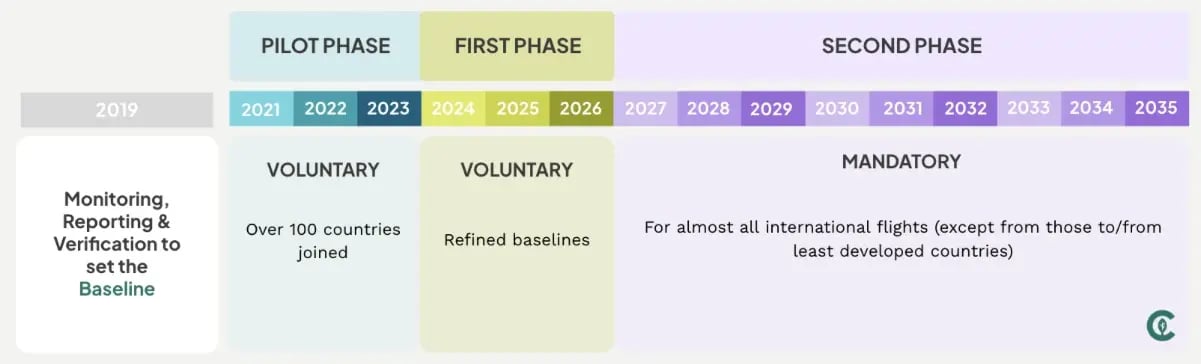
To allow the industry to anticipate and adapt, as well as letting each States gather its respective capabilities, ICAO member states agreed to implement CORSIA offsetting requirement in phases:
- Pilot Phase (2021–2023): A voluntary period where over 100 countries joined to monitor and verify data.
- First Phase (2024–2026): Also voluntary, focusing on refined baselines.
- Second Phase (2027–2035): This phase becomes mandatory for almost all international flights, excluding those to/from the least developed nations.
Note on Scope: CORSIA only applies to international routes. Domestic flights are managed under individual national climate plans (NDCs), and flights within the EEA are covered by the EU ETS.
CORSIA in Practice: MRV and Offsetting
To ensure transparency, every airline must follows the MRV (Monitoring, Reporting, Verification) process:
- Monitoring: Airlines track fuel burn for every international flight.
- Reporting: This data is compiled into an annual emissions report.
- Verification: Independent third-party auditors check the numbers for accuracy before they are reported to the ICAO Central Registry.
When emissions exceed the baseline, airlines must buy and "cancel" (permanently retire) carbon credits in an approved registry at the end of each 3-year compliance cycle. As a matter of fact, airlines do not buy credits every month, they cancel the required total of units at the end of each 3-year cycle. For example, for the cycle 2024-2026, airlines must cancel their purchased carbon credits in 2026. In addition, every tonne of CO2 must be monitored and verified by an independent third-party auditor before it is reported to the ICAO Central Registry (CCR).
What are CORSIA Eligible Emissions Units (EEUs)?
CORSIA Eligible Emission Units (EEUs) are carbon credits that airlines can use under the International Civil Aviation Organization’s Carbon Offsetting and Reduction Scheme for International Aviation (CORSIA) to offset growth in international aviation emissions. Each unit represents one metric tonne of CO₂ equivalent reduced, avoided, or removed through a carbon project in another sector.
To ensure environmental integrity, the ICAO established a Technical Advisory Body that evaluates carbon crediting programs against strict criteria. Only units issued by approved programs, such as American Carbon Registry (ACR), Architecture for REDD+ Transactions, Gold Standard, and Verra, and from specific eligible “vintages” can be used. These credits must also be tracked through secure registries with unique serial numbers to ensure full traceability from issuance to retirement.
In addition, EEUs must meet robust integrity principles:
- Additionality: They must demonstrate the reductions would not have occurred without carbon finance
- Permanence: With safeguards against reversals such as forest fires,
- Avoid double claiming: through mechanisms like Letters of Authorization under the Paris Agreement
- Comply with social and environmental safeguards: to prevent harm to local communities and ecosystems.
For more information on regulations in the aviation industry, read our article.
SAF vs. Carbon Credits: Choosing the Strategy
Airlines have two primary tools to meet their obligations: Carbon Credits (EEUs) and Sustainable Aviation Fuel (SAF).
While EEUs allow airlines to compensate for emissions by financing verified reductions in other sectors, SAF enables direct emissions reductions within aviation itself. Sustainable Aviation Fuel refers to aviation fuels produced from sustainable feedstocks such as waste oils, agricultural residues, or synthetic processes using renewable energy. Compared with conventional jet fuel, SAF can deliver significant lifecycle greenhouse gas reductions, often between 50% and 80%, depending on the production pathway.
Within the CORSIA framework, airlines can claim emissions reductions from approved SAF use, thereby lowering the amount of offsets they must purchase.
| Feature | Carbon Credits (EEUs) | Sustainable Aviation Fuel (SAF) |
| Primary Goal | Offsetting growth after it happens | Reducing emissions at the source |
| Typical Cost | $6–$25 per tCO₂ | $600–$800 per tCO₂ (Abatement cost) |
| CORSIA Impact | Meets legal obligations | Reduces offset requirement directly |
| Market Supply | Constrained by authorization issues | Below 1% of global fuel demand |
The Roadblocks Ahead
Despite its promise, CORSIA faces significant hurdles:
- Credit Scarcity: Demand is estimated at 135M tonnes, while supply is only around 18M tonnes.
- Financial Impact: Limited supply is driving price spikes; compliance costs could hit $1.7 billion annually by late 2026, potentially consuming 5–12% of airline profits.
- Integrity Risks: Ensuring additionality (that reductions wouldn't have happened without the project) and avoiding double counting (ensuring a single carbon reduction isn’t claimed by both a country and an airline) remains a high technical challenge.
- SAF Production Gap: Global SAF supply remains below 1% of demand, limiting its use as a primary tool for reducing offsets.
- Certification Rigour: Meeting strict ICAO sustainability criteria for fuels add significant administrative and operational layers.
Navigating these challenges will require a level of global coordination and technical innovation that goes beyond the current CORSIA scope. It will therefore determine the future of CORSIA whether becoming a true driver of sustainability or a financial pressure for the aviation industry.
European Commission Concept Note: Implications for Carbon Credits CORSIA Eligibility
In a move that could significantly tighten the supply of carbon offsets for European airlines, the European Commission is preparing an "implementing act" for the second half of 2026 that introduces stringent environmental integrity criteria for Phase 1 of CORSIA (2024–2026).
According to a concept note shared with its expert group on climate change policy, the Commission proposes to disqualify credits from projects using High Forest, Low Deforestation (HFLD) methodologies as well as projects with high fractions of non-renewable biomass (fNRB).
These proposed rules would effectively invalidate nearly all currently available CORSIA Phase 1 credits. While the Commission plans to use Article 6.4 of the Paris Agreement as a benchmark for Phase 2 (2027–2035), this interim move for Phase 1 aims to filter out "lowest environmental integrity" credits. As a result, market analysts suggest that only about 10% of existing supply might remain eligible if project developers choose to cancel a portion of their credits to meet the new fNRB values, a shift that is already driving European carriers toward high-integrity durable removals to hedge against future scarcity.
In Conclusion
CORSIA represents a landmark shift in how the aviation industry approaches environmental responsibility. By moving from a fragmented regulatory landscape to a unified global standard , the scheme ensures that the sector remains competitive while contributing meaningfully to the goals of the Paris Agreement.
However, the journey toward carbon-neutral growth is not without its obstacles. The industry currently faces a significant credit scarcity, with demand far outstripping the supply of ICAO-eligible units. Furthermore, the high cost of Sustainable Aviation Fuel (SAF) and the technical complexities of "Letter of Authorization" (LoA) requirements present ongoing financial and operational hurdles.
Ultimately, the success of CORSIA hinges on:
- Integrity: Ensuring every carbon credit represents a real, permanent, and additional reduction in CO₂.
- Scale: Rapidly increasing the production of SAF to bridge the current supply gap.
- Collaboration: Developing the infrastructure necessary for host nations to authorize and track credits without double counting.
As we move toward the mandatory phase in 2027, CORSIA stands as an essential framework for balancing the essential connectivity provided by international flight with the urgent need for global climate action.
How can ClimateSeed Support you in Complying with the CORSIA requirement?
ClimateSeed can support airlines in complying with the Carbon Offsetting and Reduction Scheme for International Aviation through a portfolio of 50+ verified projects delivering high-integrity carbon credits. Our experts define and understand your needs to source credits that qualify as CORSIA Eligible Emission Units (EEUs). This includes identifying credits from ICAO-approved programs such as Verra, Gold Standard, American Carbon Registry, and Architecture for REDD+ Transactions, while ensuring they meet key eligibility requirements such as additionality, permanence, and approved vintage periods.
ClimateSeed also supports due diligence by assessing project quality, verifying eligibility, and ensuring that all units are properly serialized and traceable through recognized registries, reducing compliance and reputational risk.
Beyond procurement, ClimateSeed helps airlines build a robust and auditable compliance strategy:
- Retirement documents: Credits retirement guarantee
- Double counting avoidance: Support for compliance with the Paris Agreement mechanisms
- Transparent reporting: Facilitate declarations to the International Civil Aviation Organization.
In parallel, ClimateSeed can support the integration of climate contribution strategies with in-sector decarbonization options such as Sustainable Aviation Fuel, enabling airlines to balance short-term CORSIA obligations with longer-term emissions reduction pathways.
Contact ClimateSeed to learn more about our project selection process.
Sources:
Share this

Contribution Regulations in the Aviation Industry

Carbon Offsetting vs. Climate Contribution