


Key Takeaways
The aviation industry presents a unique challenge in the transition to global Net-Zero, currently accounting for 2.5% of global CO₂ emissions. As passenger demand is projected to surge in the coming decades, the sector is shifting from a voluntary sustainability model toward a landscape defined by mandatory regulatory compliance. From the global offsetting requirements of CORSIA and the direct domestic restrictions of the French Climate & Resilience Law to the rigorous, multi-level infrastructure standards of the Airport Carbon Accreditation (ACA), the industry is under increasing pressure to decouple growth from emissions. Navigating this transition requires a proactive approach, anticipating regulatory shifts, investing in high-quality environmental contributions, and embracing the technological innovations necessary to protect our planet.
As the global community accelerates its journey toward Net-Zero, few sectors face a challenge as complex as aviation. While air travel is an indispensable industry for global trade, tourism, and cultural exchange, it remains one of the most carbon-intensive and "hard-to-abate" sectors in the global economy.
To navigate the sustainable transition of the aviation industry, a robust and evolving regulatory landscape is emerging. From global offsetting schemes like CORSIA to pioneering national legislation and infrastructure accreditation, the aviation industry is under increasing pressure to decouple growth from emissions. This article explores the various climate impacts of the aviation industry and the key regulations shaping its transition toward a sustainable future.
The Aviation Industry Impact on Climate
According to the International Energy Agency (IAE) the aviation industry accounts for 2.5% share of global emissions and contributes to 12% of all transport emissions. This number goes up to 5% share of global emissions if the condensation trails (known as contrails), the white vapor line-shape clouds behind aircrafts, are considered. At first glance, these numbers can seem small but it is a highly energy-intensive sector and one of the most challenging sectors to decarbonize.
Since 2013, aviation emissions have risen by 26% and they are estimated to reach 20% of global emissions by 2050 if we keep following the current trends.
As a matter of fact, aviation operations at altitude and on the ground have various impacts that are participating in global warming. First, it relies heavily on fossil fuels for production, and it emits combustion during the flights. It also exposes the population to health impact with regional and global air quality deterioration as well as aircraft noise pollution. Finally, it alters atmospheric chemistry and physics.
In fact, one of the biggest impacts of airplanes is linked to contrail formation created with the combination of water vapor emissions and emitted aerosols. When an aircraft passes through sufficiently cold and humid atmospheric conditions, the water vapor in the air transforms into an artificial cloud. In a mildly humid atmosphere, these contrails have a lifetime of a few minutes and therefore have a minor impact on climate. However, in a super-saturated humid atmosphere, these contrails will persist, gradually spreading into sprawling cirrus clouds, which can stay for up to 10 hours and which have a twofold impact on climate:
- A cooling effect due to the scattering of solar radiation as they filter the solar radiation coming from space.
- A greenhouse effect due to the gases inside these artificial clouds, which warms the atmosphere. Moreover these artificial cirrus clouds reflect the radiation emitted by the Earth back toward the Earth, without reflecting solar radiation back into space, therefore participating in global warming.
Last, but not least, one of the biggest challenges for civil aviation is the significant increase in yearly passenger numbers.
According to the International Air Transport Association (IATA), the number of passengers is projected to double to 8.2 billion by 2037, and the International Civil Aviation Organization (ICAO) is projecting a number of 12.4 billion by 2050. Consequently, the rise in passenger demand directly correlates with increased flight frequency and, by extension, higher total emissions.
Contribution Regulations in the Aviation Industry
To address these escalating impacts and the various decarbonization challenges faced by the aviation industry, global climate policies are evolving. In this regard, international bodies, national governments, and industry coalitions are implementing a range of regulations and frameworks.
1. CORSIA
The Carbon Offsetting and Reduction Scheme for International Aviation (CORSIA) is the first global market-based measure for any single sector. It was developed by the International Civil Aviation Organization (ICAO) to address CO2 emissions from international flights.
Instead of capping emissions directly, CORSIA requires airlines to monitor, report, and verify their emissions, and subsequently purchase high-quality carbon credits to offset any growth in CO2 emissions above an established baseline. For the period 2024-2035, airlines are required to offset any growth in CO2 emissions above 85% of 2019 levels.
👉 To learn more about how CORSIA works, read our article.
2. French Climate & Resilience Law
The French Climate & Resilience Law, promulgated in August 2021, translates 146 of the proposals from the "Citizens' Convention for Climate" into binding law. It is designed to help France meet its goal of reducing greenhouse gas (GHG) emissions by 40% by 2030 compared to 1990. This law is particularly famous for its specific restrictions on flight operations directly targeting domestic aviation.
Its key impacts on domestic aviation are the following:
- Ban on short-haul domestic flights: Prohibits domestic flights taking less than 2.5 hours where a rail alternative exists;
- Mandatory carbon offsetting for all domestic flights in mainland France;
- Restriction on airport expansions: Prohibits new airport creation or existing expansion if it results in a net increase in GHG emissions;
- Ban on aerial advertising: Prohibits the use of aircraft for advertising purposes since late 2022;
- Eco-contribution and transparency: Reinforces the "eco-contribution" (tax per ticket) and requires greater airline transparency regarding emissions, intended to fund greener transport such as rail and sustainable aviation fuel (SAF).
Focusing more on carbon offsetting requirements, the law mandates that airlines operating domestic flights progressively offset 100% of their emissions, setting a stringent precedent for national aviation policies. All aircraft operators performing commercial flights within mainland France are subject to this requirement, with an exemption for small operators emitting less than 1,000 tonnes of CO2 per year.
Moreover, from 2024, 50% of carbon credits purchased must come from projects located within the European Union with a cap at €40 per credit, to ensure a regional environmental impact. The compensation projects must also meet strict integrity criteria by being additional, measurable, verifiable, permanent, and transparent. These criteria have to be properly justified by airlines.
Projects recognized as contributing to the conservation and restoration of natural ecosystems and their functions may be eligible for an annual biodiversity bonus of up to 50% per project, allowing the aircraft operator to reduce its offset obligations by the same amount. However, it is important to notice that this bonus is subject to an annual cap of 15% per aircraft operator.
Airlines must also submit an emissions declaration on 31st of March N+1 as well as an annual compensation report verified by an independent third-party body by the 1st of June N+1. The deadline to retire purchased carbon credits is on 30th of April N+1.
👉 Contact us to learn more about our projects located in Europe.
3. Airport Carbon Accreditation
While aircraft emissions dominate the conversation, ground operations are also under strict scrutiny. The Airport Carbon Accreditation (ACA) is the only institutionally endorsed, global carbon management certification program for airports. It independently assesses and recognizes the efforts of airports to manage and reduce their carbon emissions through a multi-step framework, ranging from basic emission mapping to achieving Net-Zero.
Participating airports can be certified across 7 levels of accreditation:
- Level 1: Footprint measurement
- Level 2: Carbon management towards a reduced carbon footprint
- Level 3: Third-party engagement in carbon footprint reduction
- Level 3+: Carbon neutrality for direct emissions by offsetting
- Level 4: Transforming airport operations and business partners’ to achieve absolute emissions reductions
- Level 4+: Compensation for residual emissions with reliable offsets
- Level 5: Maintain a Net-Zero balance on scopes 1 and 2 and actively address scope 3 emissions.
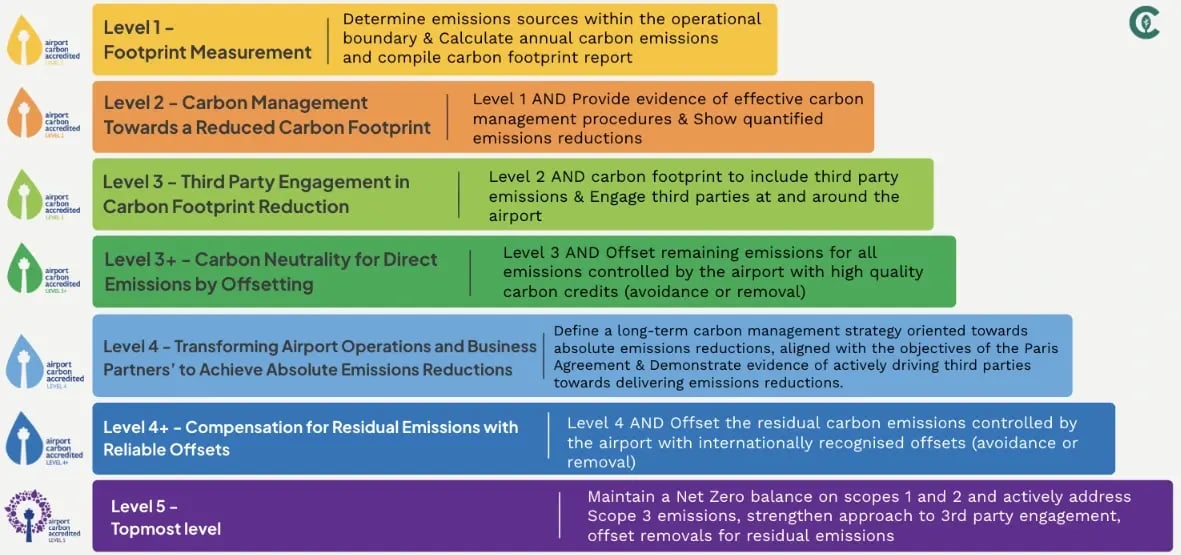
This ensures that the infrastructure supporting air travel is actively participating in the sector's decarbonization.
The aviation industry's path toward a low-carbon future is no longer a matter of voluntary corporate social responsibility; it is becoming a regulatory requirement. As we have seen, the climate impact of aviation extends far beyond fuel use, involving complex atmospheric chemistry and the challenge of doubling passenger numbers by the mid-century.
How can ClimateSeed Support Aviation Industry Players to Comply with New Contribution Regulations?
ClimateSeed is an impact-driven company that supports more than 200 organizations in their decarbonization journey. Whether you are committed to reaching net-zero, dedicated to preserving biodiversity, or looking to assess or report your GHG emissions, ClimateSeed makes it simple to achieve your sustainability goals with integrity and transparency.
Every project offered by ClimateSeed goes through a rigorous selection process, including onboarding and an evaluation assessment. Our acceptance standards are grounded in the most current scientific insights and reflect the best practices shared by respected global organizations and experts, including SBTi and ICVCM. This alignment mitigates risks and ensures that each project meets the highest standards of environmental integrity and impact.
At ClimateSeed, we work closely with you to assess your needs and refine your criteria to build a customized, high-quality carbon project portfolio. We also give you access to a wide range of credit contract types to best fit your needs.
Contact ClimateSeed to learn more about our project selection process.
Sources:
- Corporate Air France
- Airport Carbon Accreditation
- European Commission
- ICAO
- ICAO - CORSIA
- ICAO - Strategic Plan
- International Energy Agency
- République Française
Share this

Demystifying CORSIA: The Aviation Industry’s Path to Greener Skies

How to Effectively Communicate about Climate Contribution?